Salinas de Olmeda
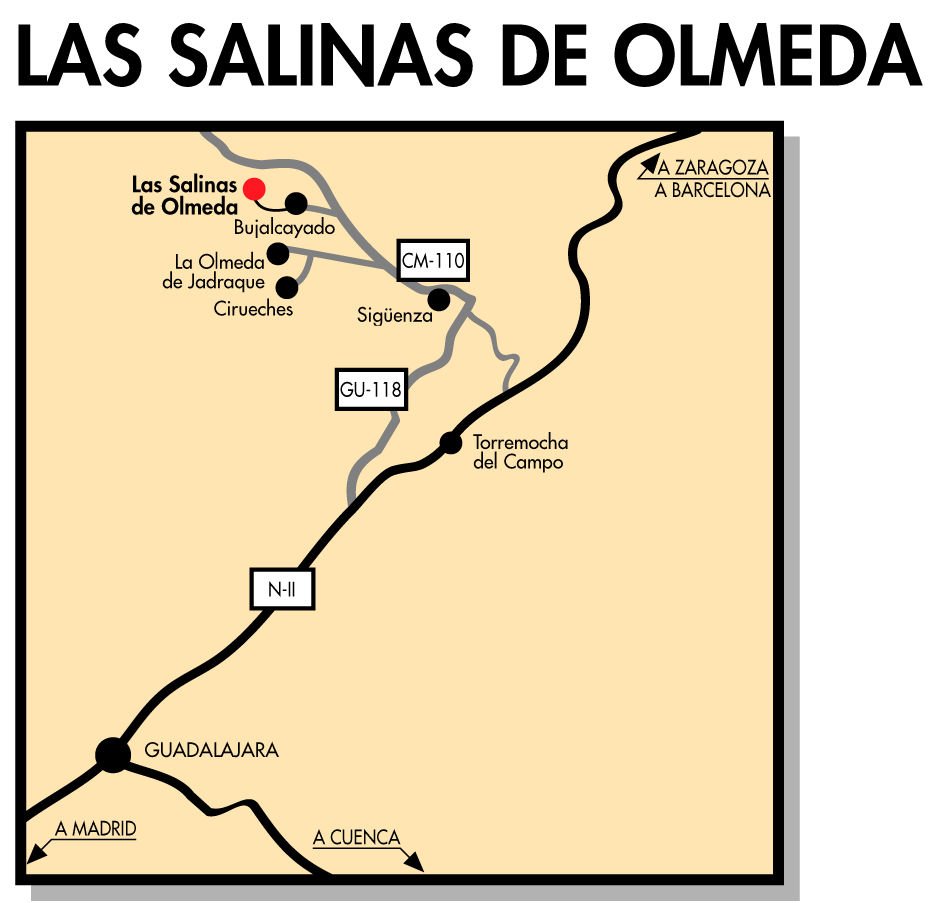
The Salinas de Olmeda are abandoned inland salt works in Guadalajara, Spain, eight kilometres north-west of Sigüenza, between La Olmeda de Jadraque and Palazuelos. For centuries they made salt from well water in hundreds of stone pans. They closed in the early 1990s, and the small settlement of workers who lived there emptied with them.
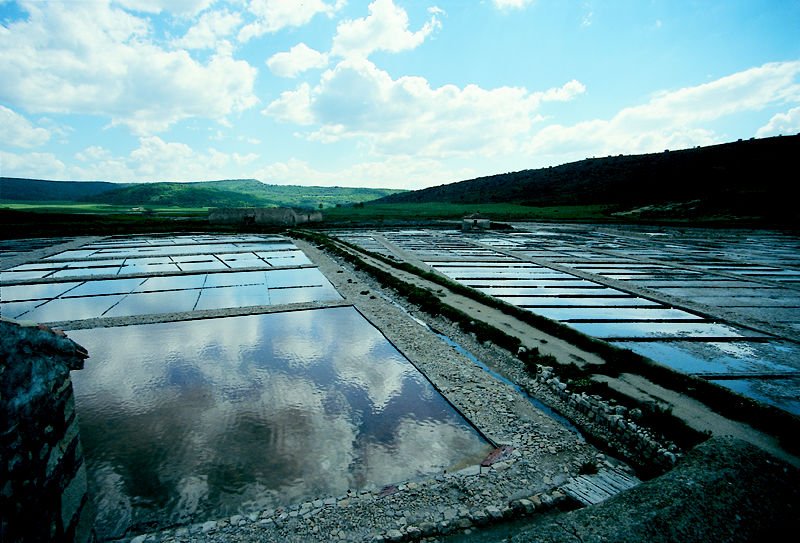
The salt works in 2000
We usually link salt works with the sea: large drying pans on a flat coast, small heaps of salt waiting to be taken away, perhaps the ruins of an old pumping windmill. That is what makes the Salinas de Olmeda such a surprising find. They are nowhere near the sea, but in the middle of Guadalajara, only eight kilometres north-west of the medieval city of Sigüenza. They spread across a plain about 936 metres above sea level, between the village of La Olmeda and the walled town of Palazuelos.
What also sets them apart is that they made salt from well water. The water came out of the ground with a high salinity of 12 degrees and was piped from the wells to the drying pans. The stone pans were 10 to 20 centimetres deep, each about the size of a tennis court, and stepped on several levels according to how salty the water was. The water was moved from pan to pan by pumps, first gas-powered and later electric, mounted on wheels so they could be moved easily. The saltiest pans lay next to the warehouses. Once the water had evaporated, the salt was scraped from the last pan, shovelled out and carried to the warehouse. The salt was pinkish, but some of it, kept for finer uses, was left in the sun to bleach.
The warehouses are enormous two-storey buildings, with great timber beams holding up very large roofs. Raw salt was stored on the ground floor and turned over with diggers. Today the floor, the walls and many of the beams are coated with a hard crust of pink salt. In the final stage the salt was crushed and carried by conveyor belts to the first floor, where it was bagged. A ramp of earth and stone led up from outside to that floor, so that carts, and later lorries, could load the sacks.
Each grade of salt had its use. The best went to curing meat and making sausages, the middle grade to feeding livestock, and the coarsest was kept for spreading on roads against ice and snow in winter.
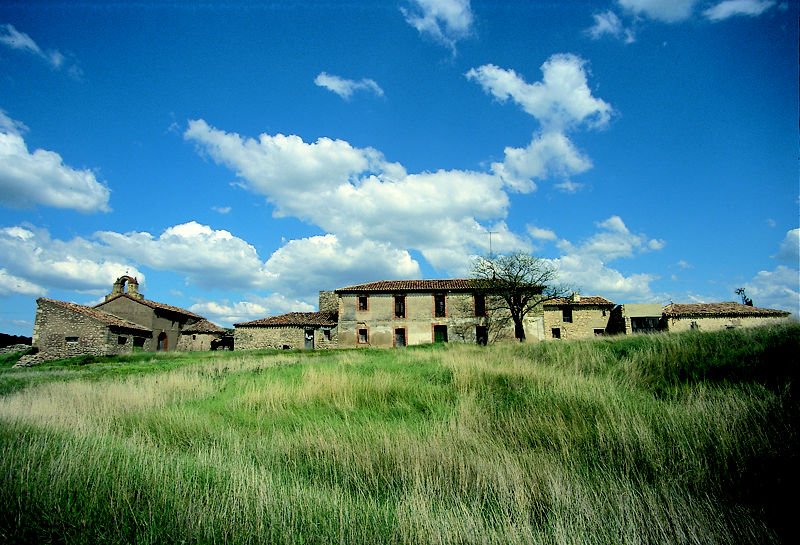
For much of the 20th century, when demand for salt was still high and the sea was far away, the salt works employed many people from the surrounding villages. Luis García Yubero, one of the last inhabitants of Bujalcayado, worked at the salt works beside his village, near the Salinas de Olmeda. Luis explains that cheap, fast access to sea salt, and winters with less snow, cut demand for the area’s coarse salt, and that the works closed in the early 1990s. Until then three people lived and worked at the Salinas, which had offices, a church and a canteen. The three shared a simple room, with a single stove for heat.
What you find when you visit today are the offices, the church and the warehouses, whole and firmly locked. But the most beautiful sight is the view of acres of stone pans, still full of pinkish water that mirrors the sky and the clouds.
History
The salt works around Sigüenza and Atienza have been worked since at least the early Middle Ages. In 1139 the tithe from the salt works of Imón and “la Bonella”, the old name of those at La Olmeda, was granted to Bernard of Agen, Bishop of Sigüenza.1 Philip II listed them in his survey of salt works in 1564. In 1873 part of them passed into private hands, and in 1888 the salt of Imón and La Olmeda won a gold medal at the Barcelona Universal Exposition.1 The surviving installations date from the 18th century.2
Current status
The works no longer produce salt, but the regional government of Castilla-La Mancha promotes them as a place to visit. According to its tourism website, only one of the warehouses the book described as intact in 2000 is still standing, and three of the five water wheels are in good condition.2 Satellite images from 2026 still show many pans holding water. The nearby Salinas de Imón have been a protected heritage site (Bien de Interés Cultural) since 1992. The salt works of the district are part of the “Sweet and Salty Landscape of Sigüenza and Atienza” bid for UNESCO World Heritage status.1
Sources
Footnotes
-
Jiménez Balbuena, Cristina. “Las históricas salinas de la Tierra de Atienza”. Spanish Federation of Municipalities and Provinces (in Spanish). ↩ ↩2 ↩3
-
Castilla-La Mancha Tourism, “Salterns – Olmeda de Jadraque”, accessed November 2026. Satellite imagery: Google Maps, 2026. ↩ ↩2
Gallery
See also
How to cite this page
Are you or a relative named on this page and would prefer the name removed, or do you have a correction, photo or memory to share? Write to [email protected].