Sotillos de Caracena and Rebollosa de Escuderos
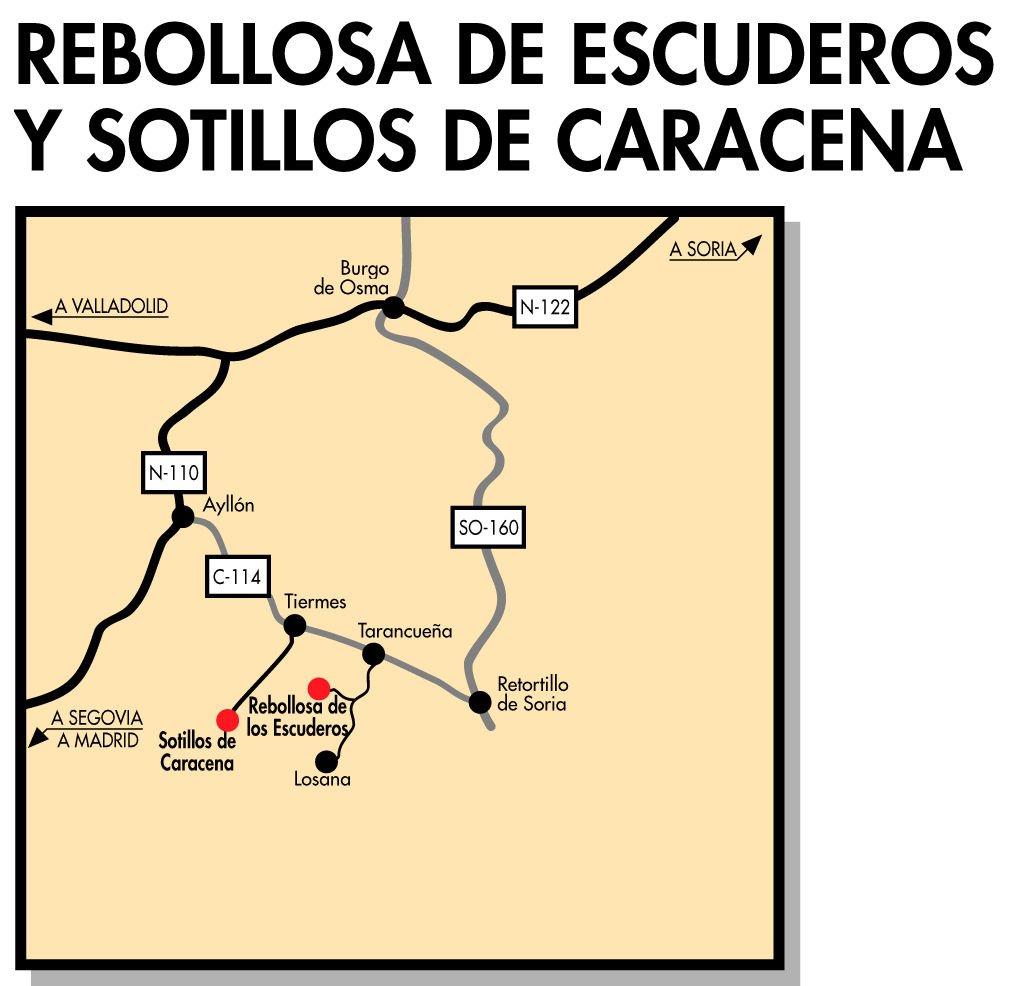
Sotillos de Caracena and Rebollosa de Escuderos are two abandoned villages in south-west Soria, Spain, at the foot of the Sierra de Pela and close to the Celtiberian and Roman ruins of Tiermes. Rebollosa emptied in 1969, when its school closed, and Sotillos in 1975.
The villages in 2000
In the south-west of the province of Soria lie the Celtiberian ruins of Tiermes. They are famous and draw visitors from all over the world. But close by are modern ruins that nobody visits: those of Sotillos de Caracena and Rebollosa de Escuderos.
The area is closed off to the south by the Sierra de Pela. Its altitude, between 1,200 and 1,300 metres, and its continental climate make for harsh winters. Conditions were poor for farming, and life was very hard for the people who lived here.
Sotillos de Caracena
Sotillos is reached by a rural track between Pedro and Tiermes. Its houses and stables were built of a mix of stone and sandstone. It had eleven households, living in two-storey houses, with their own school and church. The patron saint was Saint Michael.
They lived from livestock and the fields, but the village was badly placed. There was no water, and they had to fetch it in jugs from the fountain in Pedro. There was no electricity or telephone either, and the nearest doctor was in Montejo de Tiermes, about ten kilometres away. To travel, you crossed the Sierra de Pela with a donkey carrying the luggage and a relative or friend for company. On the far side you waited for the bus on the Atienza–Ayllón road. Once the traveller boarded, the companion took the donkey back to Sotillos. One by one, the villagers took the bus, buying one-way tickets. Sotillos de Caracena was left empty in 1975.
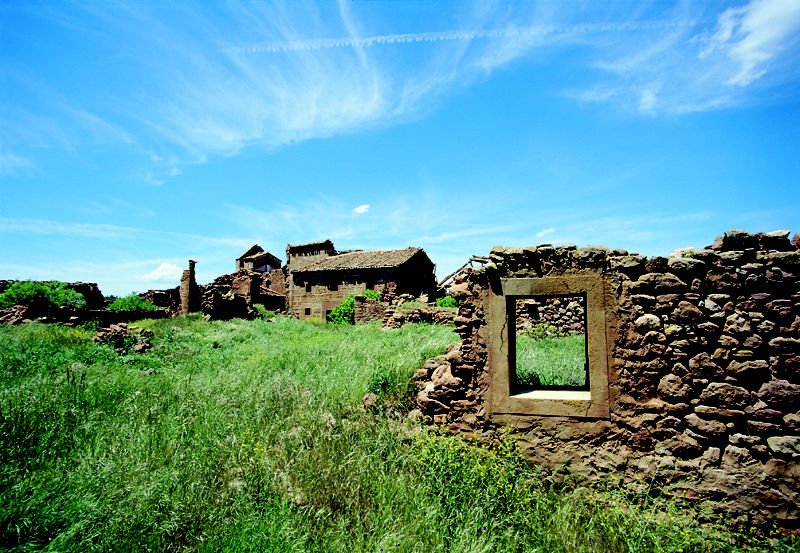
Today the ruins lay bare how the houses were built, with their beams and adobe bricks. Everything is ochre, from rain wearing away the sandstone. Next to the village lie the Matas de Pedro, a wood of oak, elm, poplar and walnut. One former villager came back to the district and became mayor of a nearby village.
Rebollosa de Escuderos
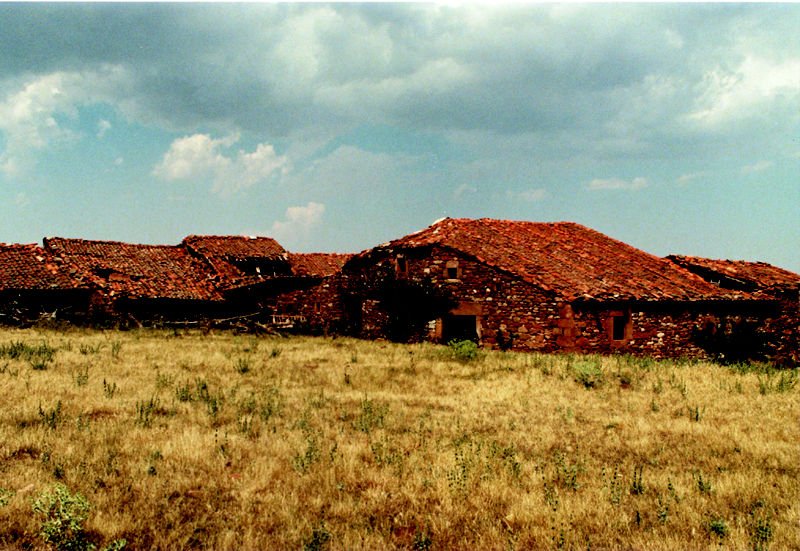
Rebollosa, by contrast, had a much better site for farming: it stood in the middle of a wheat field, which is still there. It had 15 inhabitants, with a school and a church, and drew its water with a pump. The threshing floors lay at the edge of the village, and the livestock was kept half a kilometre away at the Majadas del Monte. Villagers in the upper part of the village had vegetable gardens.
The houses were large and two storeys high. Inside, the walls were of plaster, with small hand-painted decorations. Outside everything was ochre from the sandstone, and the façades were decorated with painted panels to make them look bigger than they were.
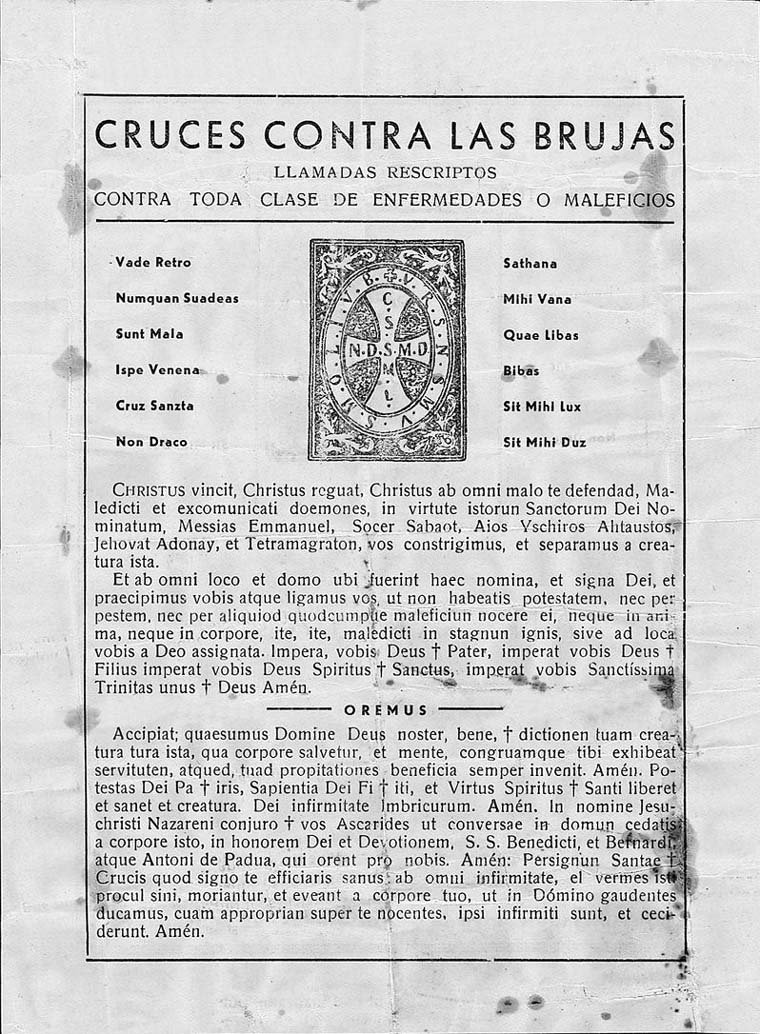
As in so many villages, there was popular religious imagery, such as the “crosses against witches” of Saint Charalampus, against every kind of illness or curse. These were printed sheets with a picture of the saint on one side and a Latin text on the other.
Rebollosa’s end came when its school closed. The children went to school in Tarancueña and stayed there. The village was finally abandoned in 1969, when many villagers left for Barcelona, Zaragoza and Madrid.
These villages, and twenty more such as Manzanares, Losana and Cañicera, had a path to the hermitage of Nuestra Señora de Tiermes, where they went on pilgrimage in June and October. Paradoxically, the hermitage itself was abandoned by 2000. Old traditions are abandoned, villages are abandoned, in the hope of finding something better. And in the end we return to the roots in the land that we need so much.
History
Both villages lie in the shadow of Tiermes, one of the most important Celtiberian and Roman cities of the Spanish plateau, known for its houses carved into the rock.
Both were always very small. In 1842 Sotillos had 8 households and 34 inhabitants, and Rebollosa 10 households and 40 inhabitants. Rebollosa reached 73 inhabitants in the 1879 census. In the mid-19th century both stopped being independent municipalities. Sotillos joined Montejo de Tiermes, and Rebollosa joined Losana and, in the late 20th century, Retortillo de Soria.12
Current status
As of November 2026, both villages are uninhabited: the national statistics office (INE) records no residents in either.12 In Rebollosa, according to the most recent sources, no house is left standing. The remains of the Romanesque-influenced church of Saints Gervasius and Protasius survive. In Sotillos the church of Saint Michael survives.
Sources
Footnotes
-
“Sotillos de Caracena”, Spanish Wikipedia, drawing on Madoz and INE (2008). ↩ ↩2
-
“Rebollosa de los Escuderos”, Spanish Wikipedia, drawing on Madoz, the 1879 census and INE (2008). ↩ ↩2
Gallery
See also
How to cite this page
Are you or a relative named on this page and would prefer the name removed, or do you have a correction, photo or memory to share? Write to [email protected].